
Breast Cancer Awareness Month: Our Commitment to Your Health
October is dedicated to women’s health and breast cancer prevention. At UPMC Salvator Mundi International Hospital you’ll find dedicated women’s prevention packages, covering both breast health and gynecological care. Take advantage of our special rates through October 31, 2026, and take care of your wellbeing.
Packages can be purchased at the special rate until October 31, 2026. Services can be completed by November 30, 2026.
Prevention Tailored to Every Woman
Breast Health Package – Under 40
- Specialist breast examination.
- Breast ultrasound.
Breast Health Package – Over 40
- Specialist breast examination.
- Breast ultrasound.
- Mammography with tomosynthesis.
Gynecological Package A
- Specialist gynecological exam with Thin Prep (or Pap test) and transvaginal ultrasound.
Gynecological Package B
- Specialist gynecological exam with Thin Prep (or Pap test) and pelvic ultrasound.
Osteoporosis Prevention
- Bone density (DEXA) scan.
Breast Cancer: What You Need to Know
Breast cancer develops in breast tissue, which includes the lobules – the glands that produce milk – and the ducts, which connect the lobules to the nipple.
It is the most common cancer among women: an estimated 1 in 8 women will develop it during their lifetime.
Over 900,000 women in Italy are living with a breast cancer diagnosis, and more than 53,000 new cases are recorded each year (source: I numeri del cancro in Italia 2025, AIOM-AIRTUM). Incidence rises mainly after age 50, but in recent years some epidemiological studies have reported an increase among younger women as well, both in Italy and across Europe.
An important and positive finding is that 5-year survival following diagnosis now stands at 88%, thanks to progress in prevention, early diagnosis, and treatment.
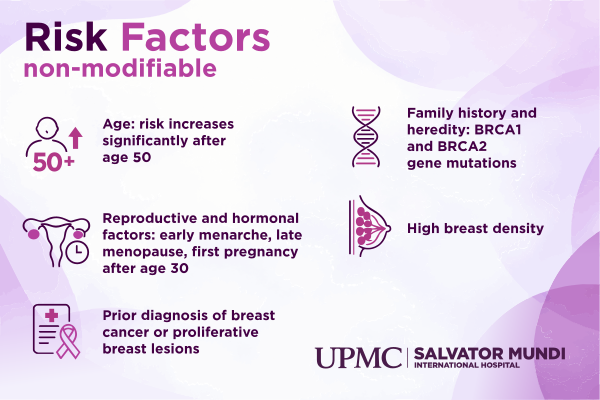
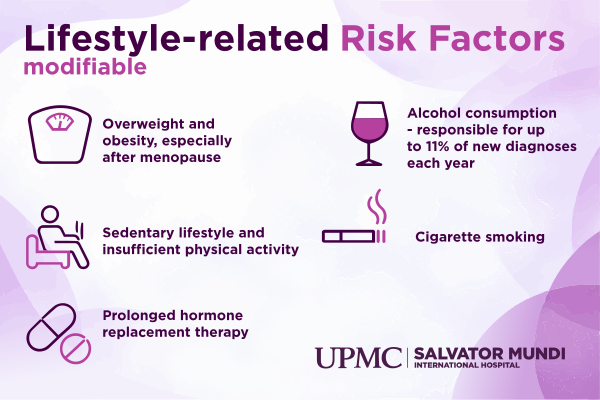
Screening Is Essential
In its early stages, breast cancer can be asymptomatic — meaning it shows no clear signs. This is why screening programs and regular check-ups are essential tools for detecting lesions while they are still small and more treatable.
Possible Symptoms of Breast Cancer
Some signs that may warrant further medical evaluation include:
- Changes to the nipple (retraction, changes in shape, or discharge).
- Swelling, thickening, or redness of the breast.
- A painless lump in the breast (the most common symptom).
- A lump or swelling in the armpit lymph nodes.
- Spontaneous nipple discharge.
The presence of one or more of these symptoms doesn’t necessarily mean cancer, but it’s always advisable to see a specialist for a thorough evaluation.
Frequently Asked Questions About Breast Cancer Awareness Month
At what age should breast cancer screening begin?
The ideal age to start breast cancer screening varies according to individual risk factors. For the general population, organized mammography screening programs in Italy typically begin between the ages of 45 and 50, with screening intervals that vary by age group. Women with a family history of breast or ovarian cancer, or those carrying BRCA1/BRCA2 mutations, should begin surveillance as early as 25 to 30 years of age, following specific protocols agreed upon with their specialist. A breast examination is the first step in identifying the most appropriate screening pathway.
Is a Pap test necessary even if you are not sexually active?
The Pap test (or HPV test) primarily detects cervical cell abnormalities caused by the Human Papillomavirus (HPV), a sexually transmitted infection. Women who have never been sexually active are at very low risk and, in consultation with their physician, may choose to postpone cervical screening. However, an initial gynecological examination is still recommended to monitor other aspects of reproductive health, regardless of sexual activity. The physician can determine the most appropriate timing on a case-by-case basis.
Is breast pain always a warning sign?
Breast pain (mastalgia) is common and is often related to cyclical hormonal changes, particularly before menstruation, or to benign conditions such as cysts or muscle tension. Only a small percentage of breast pain cases are associated with malignant lesions. Warning signs that require prompt medical attention include persistent lumps, changes in the shape or appearance of the breast, skin changes, nipple retraction, or unusual nipple discharge. If you notice any of these symptoms, or if breast pain persists without an obvious cause, consult a breast specialist.
Is family history alone enough to qualify for BRCA testing?
Access to BRCA1/BRCA2 genetic testing is not based solely on having a relative with breast cancer. Other factors are considered, including early onset of cancer in family members (typically before age 50), the number of affected first-degree relatives, the presence of ovarian cancer, male breast cancer, or specific tumor subtypes such as triple-negative breast cancer. A specialist will assess the overall family risk and determine whether genetic testing is appropriate. A breast examination is the first step in this evaluation process.