
Liver Transplant: Patients Without Anti-Rejection Drugs
19 May 2026
A major breakthrough in organ transplantation has been achieved by researchers at UPMC and the University of Pittsburgh. Through an innovative clinical trial, the team has successfully maintained several patients who underwent living-donor liver transplantation free from all immunosuppressive drugs for more than three years.
This research, published in Nature Communications, represents a significant step forward toward one of the most ambitious goals in transplant medicine: immune tolerance.
The Problem Of Anti-Rejection Drugs
Anyone who receives an organ transplant must take immunosuppressive drugs for life. These medications prevent the recipient’s immune system from attacking the organ and causing rejection, but they come with significant side effects.
Although essential for graft survival, long-term use of these drugs exposes patients to an increased risk of infections, metabolic complications, kidney damage, and a higher predisposition to certain types of cancer and diabetes.
For decades, transplant scientists have asked a compelling question: could the recipient’s immune system be “trained” to recognize the transplanted organ as friendly rather than foreign? If so, patients could finally be freed from anti-rejection drugs and their potentially harmful side effects.
The Liver And Regeneration
The liver has a remarkable biological feature: the ability to regenerate. This means that a healthy person can donate a portion of their liver to someone with end-stage liver disease, and in both individuals, the removed tissue can regrow into a fully functional organ.
Living-donor liver transplantation offers critically ill patients a second chance at life.
The Innovative Strategy: Immune Training
In 2017, a team of researchers led by Angus Thomson launched a phase I/IIa clinical trial with a specific goal: to teach the recipient’s immune system to accept the new liver. The study involved 13 patients undergoing living-donor liver transplantation.
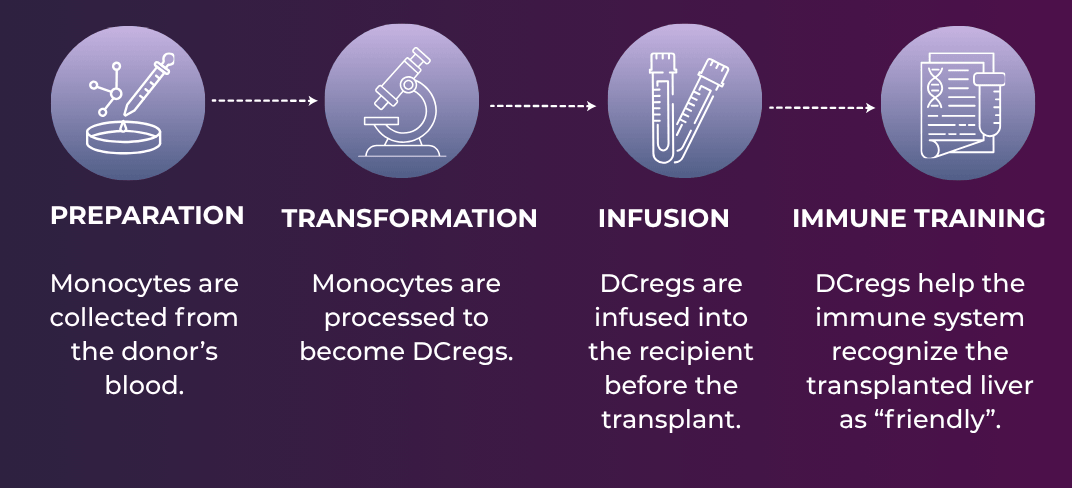
The strategy was innovative and rooted in cellular biology. A few weeks before surgery, researchers filtered specific white blood cells called monocytes from the donor’s blood. These cells were then transformed in the laboratory into regulatory dendritic cells, known as DCregs. These specialized cells play a crucial role: they train the recipient’s immune system to distinguish between potential invaders and friendly cells, preparing the ground for organ acceptance.
One week before the transplant surgery, the donor-derived DCregs were infused into the recipient. The goal was for these cells to “educate” the patient’s immune system to recognize the transplanted liver as friendly and not attack it.
The Trial Results
One year after transplantation, researchers evaluated whether patients could safely discontinue anti-rejection drugs without risking rejection.
The main results:
- 8 out of 13 patients were eligible for immunosuppression withdrawal
- 4 patients achieved complete discontinuation of medications
- 3 patients remained immunosuppression-free for more than 3 years
- 37.5% tolerance rate (vs 13% in non-study patients)
This represents a significant improvement compared to historical data. Researchers emphasize that, although promising, these findings remain exploratory due to the small number of patients involved.
However, they are sufficient to justify larger and more rigorous future studies.
A Milestone In Transplant Medicine
The Clinical Director of the Starzl Transplantation Institute described the results as a historic moment. Throughout the history of organ transplantation, tolerance has been its “Holy Grail”—the ultimate and most difficult goal to achieve.
While researchers have not yet “hit a home run,” they have clearly “reached base” by reliably and safely discontinuing immunosuppression in a significant proportion of patients within the first year after transplantation—an achievement that represents a major step forward.
Future Perspectives
Researchers explained that these results pave the way for even more ambitious studies. In particular, they plan to conduct a larger, rigorously controlled clinical trial in which half of the patients will be randomly assigned to receive DCregs and the other half standard treatment, allowing for a true direct comparison of outcomes.
In addition, the team is considering several variations of the strategy. They may test a different immunosuppressive drug than the one currently used, which could be more compatible with the action of DCregs. They may administer DCregs after surgery rather than before to assess whether this improves outcomes. They are also evaluating the possibility of deriving DCregs from deceased donors, which could significantly expand the availability of this therapy.
A New Horizon For Liver Transplantation
This work is the result of decades of research pursued by transplant scientists at the University of Pittsburgh, a tradition pioneered by Dr. Thomas Starzl, a leading figure in liver transplantation. Achieving this important milestone toward the goal of freeing patients from the toxic effects of anti-rejection drugs is a source of great satisfaction for the scientific community.
Read the press release: First-in-Human Trial Primes Immune System to Accept Donor Livers